
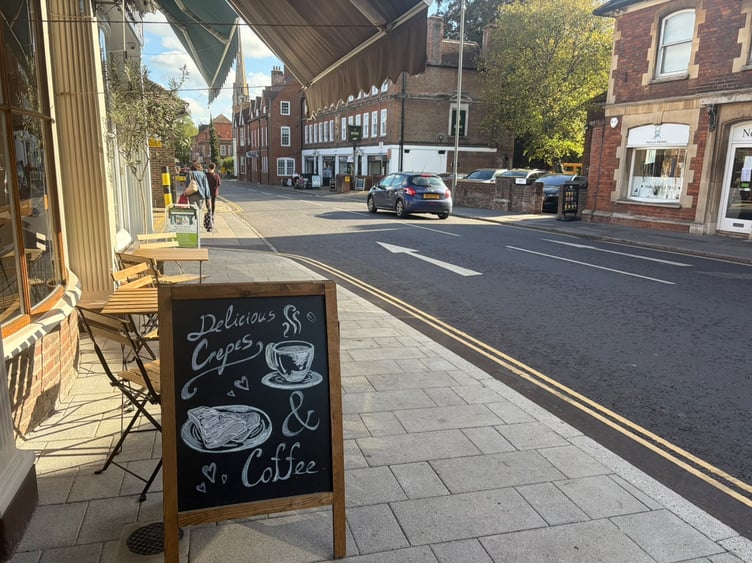
Will cafe culture plan really work?
If one of the Farnham Board's 'visions' for the 'improved' town centre is the creation of a 'cafe culture', then disappointment is imminent.
As just one example of bad design, Castle Street's pavements are now over twice as wide as what's left of the road itself, virtually all nearby parking has been removed, and instead of accommodating a bus stop within the more than ample pavement area, it's been located on the road itself – so every time a bus stops, all following traffic will have to wait behind it!
Placing loading bays almost immediately opposite bus stops in West Street also seems less than sensible.
Cafes and restaurants are struggling to cope with multiple difficulties as it is. Expecting patrons to enjoy an al fresco drink or a meal outside (when it's not too cold, hot or wet) while suffering pollution from static - or, at best, slow-moving - traffic is fanciful, to say the least.
David Argent,
Crondall
Thank you for standing against division
Thank you for your Farnham Herald front page story last week with the headline “Let's stand with our Muslim neighbours”.




In a time where gangs of masked men are aggressively pushing an intolerant ideology, spreading untrue and divisive lies, it was heartening to see a story supporting a community who have done much to bridge divides, and who have been subjected to unfounded accusations.
Matt Butler,
Farnham
Loading bays are a hazard to pedestrians
Could someone please explain how the decision was reached for Farnham town centre to require vehicles to mount a kerb in order to access the loading bays, only to find themselves on the same level as the pavements?
I have witnessed numerous vehicles actually driving on pavements, which should clearly be the domain of pedestrians. Painting a single yellow line to separate the loading bays from the pavements achieves nothing.
In my opinion, this is dangerous and an accident waiting to happen.
Michael CollisFarnham
Farnham
Common sense needed at Hickley’s Corner
The removal of the pedestrian-safety banners at Hickley’s Corner in Farnham because their permission had expired is an example of process overtaking common sense.
Surrey County Council may have legitimate rules governing signs attached to highway railings. However, if the existing banners were no longer acceptable, approved replacements should have been ready before they were removed. The choice should not be between those particular banners and no warning at all.
Hickley’s Corner has already been the scene of a fatal collision and several serious injuries. In those circumstances, removing a simple and visible safety measure without providing an alternative is unacceptable.
I am asking SCC either to reinstate the existing banners immediately on a temporary basis or to install council-approved replacement signs carrying the same clear pedestrian-safety message. Those signs should remain until permanent improvements to the junction have been completed.
The council should also explain whether a safety assessment was undertaken before the banners were removed, who authorised their removal and, most importantly, the date by which replacement signs will be installed.
Local residents have devoted their time and money to making this dangerous junction safer. They should not be left navigating an open-ended approvals process while the crossing is left without any equivalent warning.
“Permission expired” may explain the paperwork. It does not provide an adequate road-safety response.
Rob McGinn,
Frensham
Bank transfers not cheques, please
A marvellous project funded by the South Street Trust is almost complete. West Street Potters and Post 19 have collaborated on a ‘Two for One’ tile printing project. The tiles, which look magnificent, will be displayed above the Post 19 entrance.
This has been a groundbreaking venture. Post 19 has no facility for using clay and WSP has no access to printing and using screens. None of it would have been possible without the support of the South Street Trust.
Unfortunately, the whole administrative process has been dogged by a Bad Fairy who has touched her wand at every stage of the process. Finance has been just one of the many problems, due to cheques still being used for payment.
Please would any local funding body that still issues cheques think again about using bank transfer, or any method that doesn’t require the involvement of the payee?
Now banks have closed and Post Offices (so I have been told) are refusing cheques for some banks, it’s no longer an option for this method to be used.
Before someone writes to mention that an app can be downloaded, cheques photographed and sent to the bank involved, this again relies on the payee to take on a job that could be so simply accomplished, and more safely, by a bank transfer from the funder straight to the account of the receiver.
I don’t want this letter to be seen as anything other than proactive. Local trusts are often stretched by a lack of members. They do marvellously under the circumstances, but a couple of hours spent sorting this problem would save time and money for all. A bounced cheque now costs £10!
Julia Quigley,
Farnham
Deaf people shouldn’t struggle to travel
Like most of us, I don’t think twice before hopping on a bus or train to go to work, meet friends or do a spot of shopping.
However, for millions of people across the country who are deaf or have hearing loss, barriers on public transport can make even everyday journeys feel impossible.
Challenges such as inaccessible live travel information and a lack of deaf awareness among transport staff can cause huge amounts of stress and anxiety, and even force people with hearing loss to stop using public transport altogether.
These are the shocking findings in Clear Signals, a major new report from RNID which found widespread accessibility barriers on public transport in the UK.
It’s unacceptable that, in 2026, people with hearing loss are facing these barriers simply because they want to get from A to B.
We’re calling on the Government and transport sector to take action so everyone has access to the safe and independent travel they deserve.
Victoria Boelman,
Director of Policy,
RNID
Comments
We've recently changed our login process. If you have an account for commenting, you will need to re-register on the login window.
This article has no comments yet. Be the first to leave a comment.