
Has Farnham really benefited?
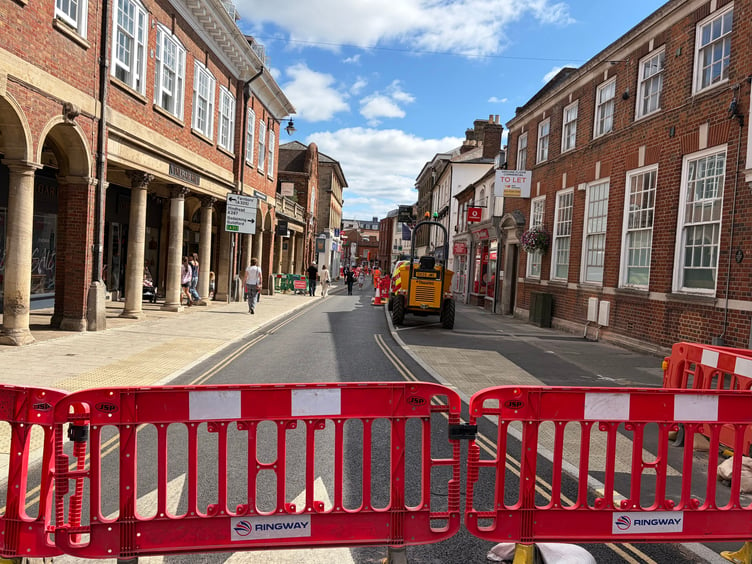
When I first saw what was happening to our streets during Farnham’s infrastructure programme, I thought, "Well, it must be for the best." I suppose I was just trusting.
But now, after all the disruption to trade and traffic, and what must be millions of pounds spent, what have we got?
I cannot see any improvement in the traffic situation. Instead of our character town, we now have what looks like a seaside town’s esplanade.
My wife tripped on one of those silly bobbled paving slabs and had to go into hospital with a fractured pelvis.
Just think what the colossal amount of money spent has achieved. Then think what use it could have been put to instead.
Mike Howick,
Mitford Court,
Farnham
-photo-Chris-Shepheard-(1)[79]-jpg.jpeg?width=209&height=140&crop=209:145,smart&quality=75)
The battle against roadside litter
I read with interest the letter from Glenn McLernon, headed ‘The shame of the A3/A272 junction’, and his litter-picking experience.
I regularly cycle along the many quiet country lanes and am saddened by the amount of discarded items, glass and plastic bottles, tins, cellophane wrappers and food containers in the grass verges, which are a scourge on the beautiful Hampshire countryside.
Last week, I had had enough and I spent two hours walking along the road between Hambledon and Clanfield in my hi-vis jacket, picking every item of litter I could off the verges and filling 3.5 black sacks of refuse.
Returning on my bicycle this week, I find a surprisingly small amount of newly discarded items where I had painstakingly been the week before.
In my local village, with four main access roads, I have to litter-pick the same sections of highway every six weeks, during which I collect four or five sackfuls of rubbish. Where I live, I have learnt to expect this, but not in rural Hampshire. I live in Surrey.
Peter Barker,
Pirbright
The pioneers of the welfare state
Thank you for your article on the Sidney and Beatrice Webb in Peeps into the Past on July 30, 2026, although I think your headline should have referred to the future PM and not MP? Nevertheless, a fascinating article.
What a site it must have been, 80 charabancs transporting 2,000 Labour members from Hampshire, Surrey and Sussex to Passfield for the garden party.
However, you fail to do full justice to the Webbs: not only did they found the London School of Economics, but they also founded the New Statesman publication, and the Fabian Society.
Their lifework, however was an unremitting life-long fight against poverty and the poor law, and the modern welfare state is in part due to their efforts.
John Gaskell,
Chair,
Farnham and Bordon Labour Party
Compassion should not be political
I have watched with growing concern the speed with which the accusation of "genocide in Gaza" has become accepted by many people as an established fact rather than a disputed legal allegation.
The suffering of civilians in Gaza is undeniable and deeply distressing. Every innocent life lost is a tragedy. At the same time, words such as genocide have a precise meaning in international law and should not be used lightly. Whether Israel has committed genocide is the subject of worldwide legal dispute and has not been determined by any court.
Public debate has become increasingly polarised. In many cases, anyone who questions the use of the term "genocide" risks being dismissed or vilified rather than engaged with in thoughtful discussion. That should concern anyone who values free and informed debate and facts.
Equally troubling is the apparent fading from public consciousness of the atrocities committed by Hamas on October 7, 2023. More than 1,200 people were murdered in southern Israel, more than 250 were taken hostage, and communities were devastated.
The victims included babies, children, young adults and the elderly. Survivors and investigators have documented acts of murder, mutilation, sexual violence, torture and kidnapping carried out during those attacks.
One of the worst atrocities occurred at the Nova Music Festival, where hundreds of young people from many countries and backgrounds had gathered simply to celebrate music, nature and love. Their lives were shattered when Hamas gunmen attacked the festival, murdering 360 people and taking others hostage.
The Nova Exhibition, which came to London, sought to preserve the memory of those victims and what happened on that day. It presented photographs of those who were murdered, testimony from first responders, personal belongings recovered from the site, and accounts from bereaved families and former hostages. Whatever one's political views, it was impossible not to be affected by the human stories it told.
Among those visitors was Boy George. Deeply moved by the exhibition, he wrote the song We Will Dance Again. Instead of receiving universal support for recognising their suffering, he faced intense criticism and abuse from some quarters. This affected him professionally, and he had to pull out of Jesus Christ Superstar because of concerns for his safety.
Compassion should never be selective. We should be able to mourn Israeli victims of terrorism without diminishing the suffering of Palestinian civilians. Likewise, we should be able to grieve for innocent Palestinians without excusing or ignoring the crimes committed by Hamas.
Humanity is not a finite resource. Empathy is not a political statement.
If our society has reached the point where expressing sympathy for victims of rape, murder, kidnapping and terrorism results in abuse or intimidation, then something has gone badly wrong with our public discourse.
We do not have to agree on every aspect of this tragic conflict. But we should surely be able to agree that every innocent life has equal value, that terrorism must be condemned unequivocally, and that compassion should never depend upon the nationality, religion or ethnicity of the victim.
If we lose sight of those basic principles, we risk losing something fundamental about our own humanity.
Sylvia Forman,
Address supplied
A champion for British wildlife
Everyone at the RSPCA is deeply saddened by the loss of our former vice president Bill Oddie OBE.
While his comedy, music and, of course, work with The Goodies delighted so many, his tireless commitment to British wildlife will define so much of his extraordinary life.
Bill was an exceptional and steadfast champion for the natural world, whose passion for birds and wildlife was truly infectious.
He campaigned tirelessly alongside his many friends at the RSPCA - including taking the fight to governments against plans to cull badgers.
I know many of our wildlife rescuers were inspired into animal welfare by Bill's groundbreaking broadcasting work and incredible knowledge of British birds, which brought the wonders of nature into millions of homes across the country.“Nature has lost one of its best friends, fiercest champions and most iconic defenders.
Our thoughts are with his family, friends, and the countless people he inspired to spend time birdwatching, to cherish nature, and to build a kinder world for animals.
Jo Rowland,
Chief Executive,
RSPCA
Comments
We've recently changed our login process. If you have an account for commenting, you will need to re-register on the login window.
This article has no comments yet. Be the first to leave a comment.