
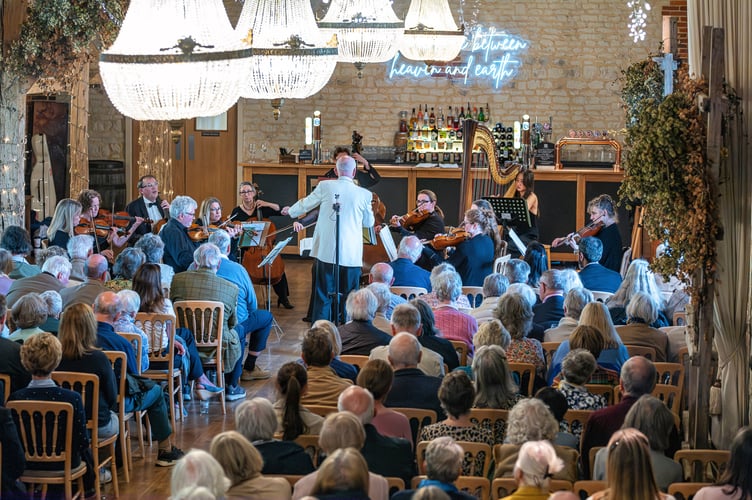
Farnham Sinfonia charmed the audience with a fascinating programme of mainly Romantic music under the expert direction of Matthew Taylor at Bury Court Barn in Bentley on May 10.
The concert featured interconnected works ranging from Mozart to Clara Schumann, showcasing polished and committed string playing.
Highlight of the afternoon was a pairing of Clara and Robert Schumann works, orchestrated by Matthew, featuring solo violin and oboe.
A set of three Lieder by Clara, transcribed for violin, were superbly played by 19-year-old soloist Clara-Sophia Wernig.



Her beautifully shaped phrasing and heartfelt passion brought out the singing tone of the violin which she communicated effortlessly to an enthralled audience.
Matthew’s addition of harp added richness to the texture supporting the soloist’s soaring, poetic melodies. The words of the songs were not even missed, such was this promising young violinist’s projection.
Robert Schumann didn’t write an oboe concerto, but Matthew went some way to compensating with his orchestration of the composer’s Three Romances (1849) for piano and oboe.
Matthew said Schumann had particular affinity with the oboe, often bestowing the instrument with poignant melodies in his other works, for example in the piano concerto.
Oboe soloist James Turnbull gave a masterclass in exploring the technical and expressive possibilities of his instrument.
He displayed assured dynamic control, articulation, tone colour and intonation, highlighting its singing, poetic quality.
Matthew’s orchestration of the original piano accompaniment, transforming the romances into a concertino, employed pizzicato and sometimes syncopated rhythms to evoke an atmospheric painting in music.
Matthew said he liked “connections between music”, and the programme reflected this.
Mozart was “Sibelius’ God,” said Matthew. The programme began with Sibelius’ Andante Festivo, a five-minute tone poem with profoundly moving melodies and majestic musical contours reflecting Mozart’s serenity and perfection.
Next came Mozart’s Adagio and Fugue in C Minor, written after a period of immersion in the works of J S Bach.
This austere work is dominated by contrapuntal virtuosity without losing Mozart’s characteristic grace and elegance.
The Sinfonia showed assured command of voicing, as angular and chromatic motifs were passed around the orchestra in the fugue.
Individual string sections coped well with exposed intonation in this demanding work. Those familiar with Mozart’s late symphonies may have heard parallels with the Sturm und Drang 18th-century artistic movement as this intense piece moved to a climactic finale.
The conductor drew a connection between Elgar and Schumann in their command of the miniature form - their ability to conjure lyrical imagery with great economy of means.
Elgar’s Sospiri, meaning ‘sighs’, did not disappoint. The Sinfonia delivered this near-perfect five-minute musical poem, scored for string orchestra with harp, with confidence and expressive warmth.
The concert ended with a firm favourite, Elgar’s Serenade for Strings, again eliciting a stylish performance.
The band seemed comfortable in a late Romantic, English idiom. Matthew’s spacious tempo allowed the full ebb and flow of the surging string writing to be appreciated.
Elgar’s elegiac themes carry a sense of joy and affirmation - a style of music at home in this glorious and bucolic Hampshire setting.
Sarah Hard
Comments
We've recently changed our login process. If you have an account for commenting, you will need to re-register on the login window.
This article has no comments yet. Be the first to leave a comment.