
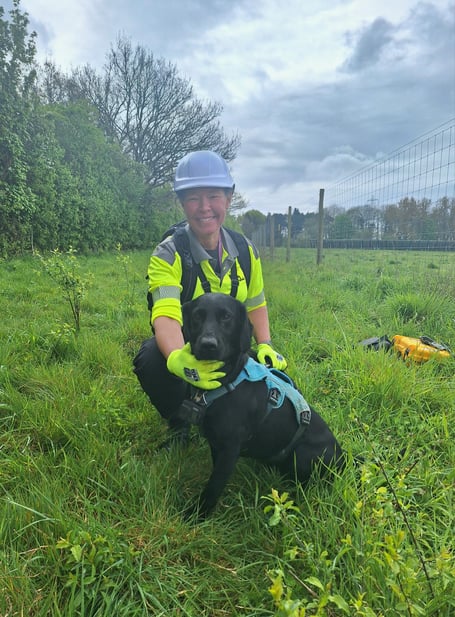
A pack of pups are following their noses to track down leaks on water pipes.
Sniffer spaniels Mylo, Kilo and Tico are trained to detect the scent of chlorine from treated water, enabling them to identify leaks on pipes even several metres below ground.
Alongside their ex-military and police handlers, Stephanie Barrett and Lewis Worley, from canine-assisted detection team CAPE SPC, they are helping Southern Water to find leaks in hard-to-access parts of rural Hampshire – with a 95 percent accuracy rate.



The dogs follow the route of water mains, moving in a zigzag pattern to cover around 7km each day. They lie down when they find an area of interest, allowing their handler to confirm a leak either by testing surface water for chlorine or via acoustic confirmation, before logging the location for follow-up by Southern Water’s teams.
In the 30-day period Southern Water has been trialling CAPE’s ‘olfactory technology’, the dogs have accurately identified around 20 leaks across water-stressed Hampshire that would have been difficult to find with standard techniques.
Dr Nick Mills, director of environment and innovation at Southern Water, said: “We’re committed to cutting network leakage by 50% by 2050, and hitting that target means combining prevention with smarter, faster detection. Rural areas have long posed a challenge in identifying leaks, and CAPE’s dogs offer a promising solution that complements existing approaches such as acoustic network sensors and our work upgrading water mains across the region. By combining data, technology, skilled people and innovation, we can cut bursts, reduce interruption to supply and ensure future resilience for the network.”
Southern Water’s network spans towns, cities and large rural areas, with pipes of different ages, materials and sizes. Because of this, leaks do not all present in the same way. Surface-level leaks are often reported by customers or spotted by teams and repaired quickly by reactive crews.
Others occur underground and are usually identified by monitoring flow and pressure data with acoustic sensors. However, these methods are less effective in rural areas, where the sound of a leak travelling along a pipe does not always carry. This is where detection dogs can help. Using scent rather than sound, they can cover large areas quickly, pinpoint leaks accurately, and even help improve the mapping of older pipes.
CAPE SPC is the only company in the UK delivering canine-assisted leak detection and is the first in Europe to develop the service.
Handler Lewis Worley said: “While there’s no denying our dogs are cute, these are working animals specially trained to carry out a job. Dogs have up to 300 million olfactory receptors in their noses, where humans only have about six million.
“Day after day, we see them sniff out leaks in remote and hard-to-access areas that may otherwise have gone undetected. We all know how effective dogs are when it comes to detecting explosives or drugs, and CAPE is excited to be leading the way in demonstrating how they can help water companies.”
Comments
We've recently changed our login process. If you have an account for commenting, you will need to re-register on the login window.
This article has no comments yet. Be the first to leave a comment.